
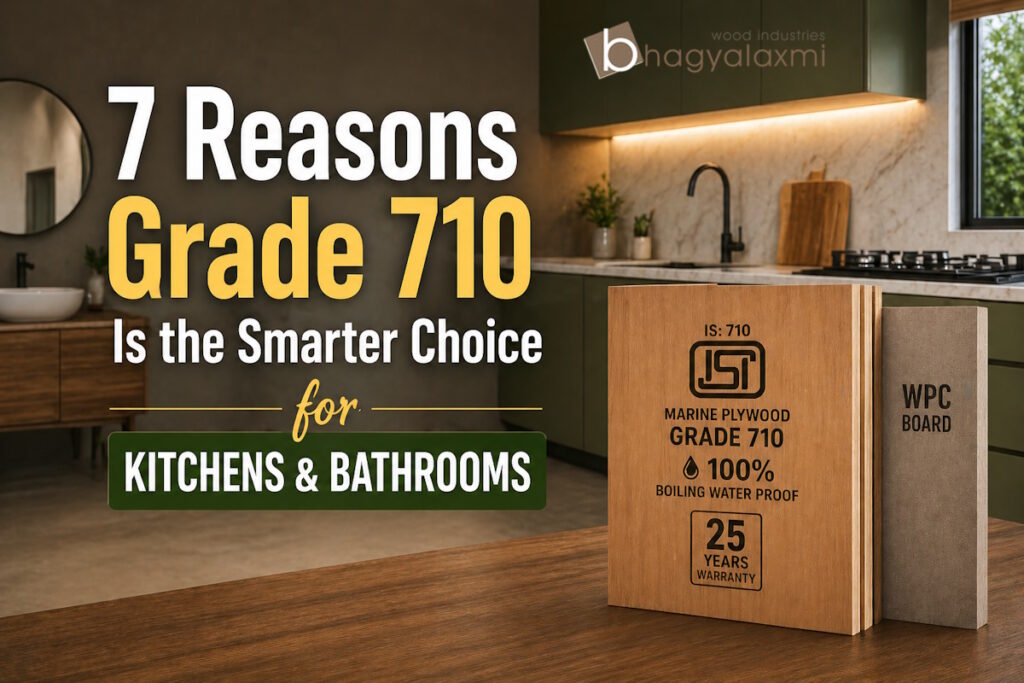
Understanding the Material Debate: WPC vs Marine Plywood
In the modern Indian interior market, the choice of core material is the most critical decision for any project.
With high-moisture zones like kitchens and bathrooms being focal points, homeowners and contractors often weigh the benefits of Wood Plastic Composite (WPC) against industry-standard BWP Grade 710 Marine Plywood.
Understanding the structural differences is essential to ensuring your furniture stands the test of time.
While WPC offers complete water resistance, it often falls short in structural rigidity and long-term mechanical performance. Marine plywood, especially Grade 710, is engineered to handle moisture while delivering the load-bearing strength required for heavy-duty cabinetry and architectural structures. This article explains why, in the debate of plywood vs WPC board, engineered plywood remains the preferred choice for professionals.
Need help choosing the right material?
1. Superior Structural Rigidity and Load-Bearing Capacity
The Engineering behind Plywood Strength
Marine plywood is composed of multiple layers of veneers bonded with high-grade synthetic resins. This cross-laminated structure ensures that the board remains rigid under heavy loads. Unlike WPC, which can exhibit sagging or bowing when used in long spans, plywood maintains its shape, making it ideal for shelves, heavy kitchen cabinets, and structural furniture components.
Why Load-Bearing Matters
In residential and commercial construction, the ability of a material to support weight without deformation is paramount. Plywood distributes pressure evenly across its grain layers, whereas WPC often lacks the internal density to support heavy loads over long periods without supplemental framing.
2. Screw-Holding Strength and Assembly Longevity
The Mechanics of Fastener Retention
A primary concern in the wpc vs marine plywood comparison is how well hardware stays fixed to the material. Marine plywood features a dense, multi-layered core that grips screws effectively. This is vital for cabinet doors and drawers that are subject to constant movement and mechanical stress.
The WPC Limitation
WPC is notorious for failing at screw points. Over time, hinges and slides tend to loosen because the material does not possess the same fibrous density as treated plywood. For high-traffic furniture, this loss of fastener integrity leads to premature repairs and hardware replacement.
3. Proven Performance in Indian Climate Conditions
Thermal Stability and Expansion
India experiences extreme temperature fluctuations, which can cause significant dimensional changes in synthetic materials. While WPC is waterproof, it is highly sensitive to heat, often expanding or contracting in ways that can warp cabinet frames. Grade 710 plywood is specifically manufactured to withstand these shifts without compromising its structural integrity.
Why Compliance with ISI Standards Matters
Choosing certified plywood from reputable plywood manufacturers in India ensures that your material meets strict moisture-resistance standards. ISI marks on Grade 710 products serve as a guarantee that the board has undergone rigorous boiling water proof testing, ensuring stability in humid coastal areas and dry inland climates alike. If you are wondering how to check plywood quality, always inspect the ISI certification, surface finish, core gaps, uniform thickness, and bonding strength before purchase.
4. Sustainability and Natural Aesthetics
The Environmental Choice
For those prioritizing sustainable building materials, wood remains the premier choice. Plywood utilizes managed timber resources, and modern manufacturing processes ensure that waste is minimized. Furthermore, the aesthetic appeal of a wood surface cannot be replicated; it provides a natural base for laminates and veneers that simply looks and feels better in a residential setting.
Veneer Quality and Finishing
High-quality marine plywood is widely preferred as waterproof plywood for kitchens, bathrooms, and other moisture-prone interiors. It offers a smooth, uniform surface that is perfect for high-end finishes. Whether you are using laminates, acrylics, or wood veneers, the substrate quality of plywood ensures a professional finish that stays flat and smooth for years.
Need premium Grade 710 plywood at the best price?
5. Cost-Efficiency over the Product Lifecycle
Avoiding Frequent Replacements
When analyzing the cost of wpc vs marine plywood, it is important to look beyond the initial purchase price. While synthetic boards may seem cheaper upfront, the maintenance and replacement costs of hardware and the structural degradation of the material can lead to higher long-term expenses. Marine plywood offers the best balance between initial cost and long-term durability.
Value for Money
Investment in Grade 710 ensures you are not revisiting your interior work in five years. By choosing high-quality wood products from established factory-direct manufacturers, you reduce the risk of structural failure and increase the resale value of your property.
6. Ease of Fabrication and Installation
Contractor Preference and Workability
Contractors across India prefer working with plywood because it is easy to cut, route, and join using standard carpentry tools. The workability of plywood allows for intricate designs and custom joinery that would be difficult or impossible to achieve with WPC. This translates to lower labor costs and more efficient project timelines.
Standardized Sizes and Thicknesses
Plywood is available in a wide range of thicknesses, from 6mm to 25mm, allowing for precise engineering in cabinetry and construction. This versatility makes it the preferred substrate for everything from basic partitions to heavy-duty kitchen carcasses.
7. Chemical Resistance and Biological Protection
Treatment against Termites and Borers
The manufacturing process for high-grade marine plywood involves intensive preservative treatments. These treatments protect the wood from termite attacks and fungal decay, which are common issues in many parts of India. When you source from reliable plywood manufacturers in India, you are getting a product treated to withstand biological threats, providing a level of protection that many WPC boards cannot offer without added chemical coatings.
Long-term Peace of Mind
Quality control in marine plywood production ensures that the core is uniform and protected. This provides the end user with peace of mind that their interiors are shielded against common environmental damage, making it a safer investment for both residential and commercial spaces.
Ready to build with certified marine plywood?