
Choosing the best ply for home furniture is one of the most important steps when planning a new home, renovating a room, or making custom furniture.
Plywood may not always be visible after the final finish, but it decides the strength, life, and feel of your furniture.
In Indian homes, plywood is used for beds, wardrobes, kitchen cabinets, TV units, shoe racks, study tables, wall panels, and many other items.
Since Indian weather can change from dry summers to heavy monsoon humidity, it is important to choose the right plywood for each area of the home.
This simple plywood buying guide will help you understand the best plywood for furniture, different plywood grades, thickness options, quality checks, and tips to choose durable plywood that lasts for years.
Not sure which ply is best for your home furniture?
What Is Plywood?
Plywood is an engineered wood product made by joining thin layers of wood veneer with strong adhesive. These layers are placed in opposite grain directions, which gives plywood good strength and stability. This structure makes plywood stronger than many basic wood boards.
Good quality plywood does not bend easily, holds screws well, and can carry weight when used correctly. That is why plywood is widely used in Indian furniture making.
Why Plywood Is Popular for Indian Home Furniture
Plywood is popular because it gives a good balance of strength, price, and design flexibility. It can be cut into many shapes and finished with laminate, veneer, paint, or polish.
For Indian homes, plywood is often better than solid wood in many cases because it is more stable and less likely to shrink or expand with weather changes. It is also easier to use for modular furniture.
Another reason plywood is preferred is that it comes in many grades. This means you can choose normal plywood for dry areas and water-resistant plywood for kitchens or bathrooms.
Types of Plywood Used in Indian Homes
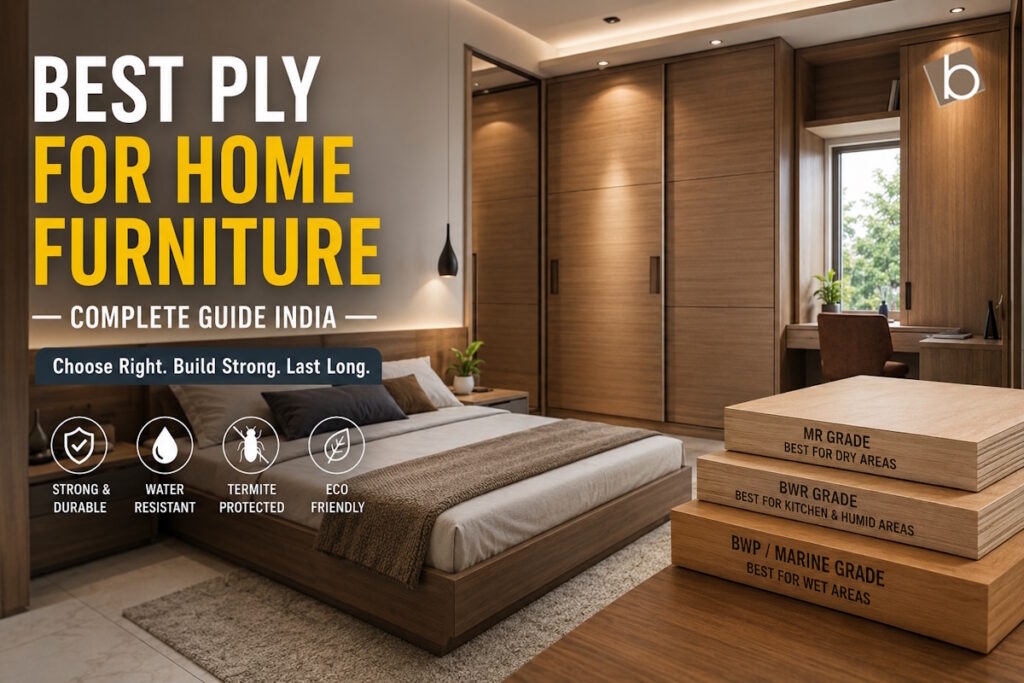
To find the best ply for home furniture, you need to understand the main plywood grades.
1. MR Grade Plywood
MR means moisture resistant. It is also called commercial plywood. This plywood is suitable for dry indoor areas such as bedrooms, living rooms, study rooms, and wall panels.
MR plywood can handle normal indoor moisture, but it is not waterproof. So, it should not be used in kitchens, bathrooms, or areas where water contact is common.
Best use:
Wardrobes, beds, dressing tables, bookshelves, TV units, and basic indoor furniture.
2. BWR Grade Plywood
BWR means boiling water resistant. This plywood has better water resistance than MR grade plywood. It is a good choice for areas where furniture may face humidity or light water exposure.
BWR plywood is commonly used in Indian homes because it gives better protection during monsoon and is suitable for long-term furniture use.
Best use:
Kitchen cabinets, bathroom storage, utility cabinets, dining units, and furniture in humid cities.
3. BWP or Marine Grade Plywood
BWP means boiling water proof. It is also known as marine plywood.
BWP plywood has very strong bonding and can handle high moisture better than MR and BWR plywood. It is usually more expensive, but it is a smart choice for wet areas.
Best use:
Kitchen cabinets below the sink, bathroom furniture, balcony cabinets, and areas close to water.
Which Is the Best Ply for Home Furniture?
The best ply for home furniture depends on where the furniture will be used. There is no single plywood that is best for every place.
For dry indoor furniture, good quality MR grade plywood can work well. For kitchens and humid areas, BWR plywood is a better option. For areas with regular water contact, BWP or marine plywood is the safest choice.
A smart way to choose is:
- Use MR plywood for dry rooms
- Use BWR plywood for kitchens and humid areas
- Use BWP plywood for wet and high-risk areas
This helps you balance quality and budget.
Best Plywood for Furniture by Room
Bedroom Furniture
For beds, wardrobes, side tables, and dressing units, MR or BWR plywood works well. If your city has high humidity, BWR plywood is a better choice.
For wardrobes, choose plywood that holds screws firmly and does not bend. A thickness of 18 mm is commonly used for main furniture panels.
Living Room Furniture
For TV units, bookshelves, wall panels, and display units, MR plywood is usually enough if the area is dry. If the wall has dampness, choose BWR plywood.
For floating shelves, make sure the plywood is thick and strong enough to hold weight.
Kitchen Furniture
The kitchen needs more care because it faces heat, steam, oil, and water. BWR plywood is a common choice for kitchen cabinets. For the sink area, BWP or marine grade plywood is better.
If you want premium plywood for kitchen furniture, choose BWP plywood for all lower cabinets and BWR plywood for upper cabinets.
Confused between MR, BWR, and BWP plywood?
Bathroom Furniture
Bathroom storage units should use BWP plywood because bathrooms have high moisture. Even if water does not directly touch the furniture, the air is usually damp.
Also, use good edge sealing and waterproof laminate for extra safety.
Study Room Furniture
For study tables, book racks, and cabinets, MR plywood is fine in dry areas. If the furniture will carry many books, choose strong and thick plywood.
Balcony or Utility Area Furniture
For balcony cabinets, washing machine cabinets, or utility storage, BWP plywood is the best option. These areas often face moisture, dust, and changing weather.
Best Thickness for Home Furniture
Thickness is very important when choosing plywood. Even the best plywood for furniture will not perform well if the wrong thickness is used.
Common plywood thickness options are 6 mm, 9 mm, 12 mm, 16 mm, 18 mm, and 25 mm.
6 mm Plywood
Used for drawer bottoms, back panels, and light partitions.
9 mm Plywood
Used for cabinet backs, wall panels, and light furniture parts.
12 mm Plywood
Used for small cabinets, shelves, and light doors.
16 mm Plywood
Used for medium furniture panels and some modular furniture.
18 mm Plywood
This is one of the most common choices for home furniture. It is used for wardrobes, beds, kitchen cabinets, tables, and main furniture bodies.
25 mm Plywood
Used for heavy-duty furniture, thick table tops, and areas that need more strength.
For most Indian home furniture, 18 mm plywood is a safe and popular choice.
How to Check Plywood Quality Before Buying
Before you invest in furniture, it is important to check plywood quality carefully. Many plywood sheets may look similar from the outside, but their strength and durability can be very different. A simple quality check can help you avoid weak or low-grade plywood.
Check the ISI Mark
Look for ISI marking and grade details on the plywood sheet.
Check the Core
The core should be even and gap-free. If there are many gaps inside the plywood, it may become weak over time.
Tap the Sheet
Tap the plywood surface. A good sheet gives a solid sound. A hollow sound may mean gaps inside.
Check the Edges
Look at the side of the plywood. The layers should be even and tightly bonded. If the layers are loose, avoid that sheet.
Check for Bending
Place the plywood sheet on a flat surface. It should not be badly bent or twisted.
Ask About Treatment
Good plywood should have protection against termites and borers. This is very important in Indian homes.
Why Durable Plywood Matters
Furniture is a long-term investment. If you choose cheap and weak plywood, you may save money in the beginning but spend more later on repairs.
Durable plywood gives better screw holding, better weight support, and longer life. It also helps your laminate or veneer finish stay smooth for a longer time.
Durable plywood is especially important for:
- Kitchen cabinets
- Wardrobes
- Beds
- Storage units
- Bookshelves
- Bathroom cabinets
These furniture items are used daily, so they need strong material.
Premium Plywood: Is It Worth It?
Many people ask whether premium plywood is worth the extra cost. The answer depends on your use.
Premium plywood is usually made with better raw material, stronger bonding, better core quality, and improved protection against termites and moisture.
It is worth buying premium plywood for kitchens, wardrobes, beds, and bathroom furniture. These items are used for many years, so better quality makes sense.
For small, low-use furniture, you can choose a more budget-friendly plywood if the room is dry.
Plywood vs MDF vs Particle Board
Many homeowners get confused between plywood, MDF, and particle board.
When comparing plywood vs MDF vs particle board, plywood is usually the strongest and most durable option, while MDF offers a smoother finish for painted furniture and particle board is a more budget-friendly choice for low-use furniture.
For Indian homes, plywood is usually the better choice for strong and long-lasting furniture.
Best Ply for Modular Furniture
Modular furniture needs plywood that can handle cutting, drilling, screws, and daily use. For modular wardrobes and kitchens, BWR plywood is a good choice. For kitchen sink areas, use BWP plywood.
If your budget allows, use premium BWR or BWP plywood for modular furniture. It will give better life and fewer repair issues.
Common Mistakes to Avoid While Buying Plywood
Many buyers focus only on price. This is a mistake. Cheap plywood may have poor bonding, low-quality core, and less protection.
Avoid these mistakes:
- Do not buy plywood without checking the grade
- Do not use MR plywood in wet areas
- Do not ignore thickness
- Do not buy from unknown sellers without a bill
- Do not skip termite protection
- Do not choose plywood only by brand name
- Do not forget edge sealing
Final Recommendation
The best ply for home furniture is the one that matches your room, use, and budget. For normal indoor furniture, MR or BWR plywood can work well. For kitchens, BWR plywood is better. For sink areas, bathrooms, and wet spaces, BWP or marine grade plywood is the best choice.
A good rule is simple: choose stronger plywood for areas that face water, weight, and daily use. Choose trusted, ISI-marked, gap-free, and termite-resistant plywood.
When selected properly, plywood can give your furniture strength, beauty, and long life. So, before you start making furniture, use this plywood buying guide to choose wisely. A good plywood choice today will save money, time, and stress in the future.
Ready to build strong and long-lasting furniture?