
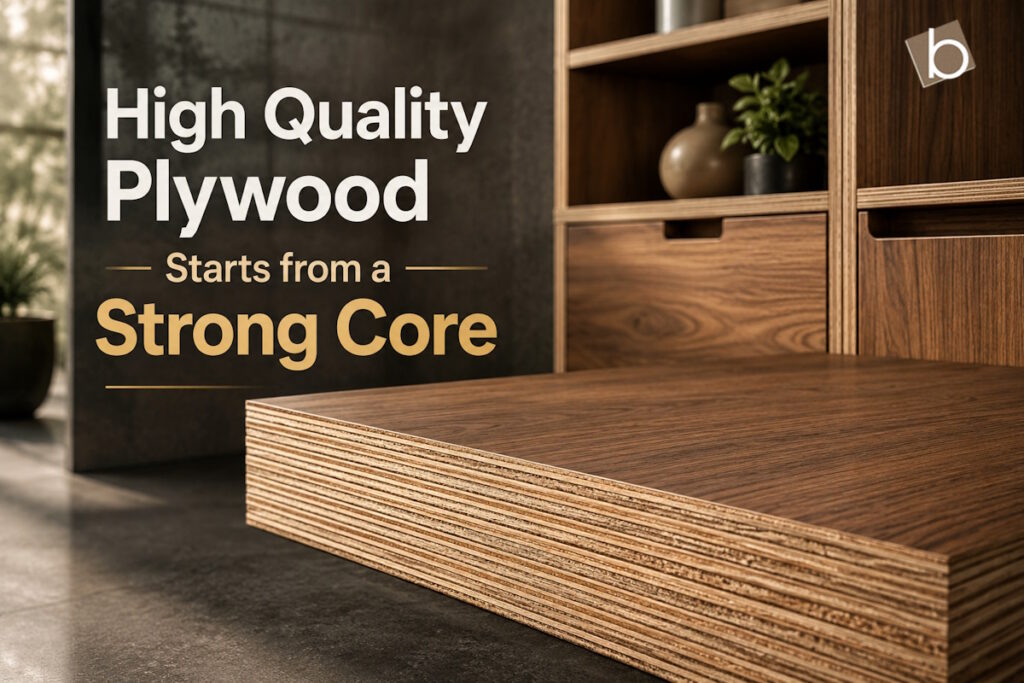
Understanding the Hidden Integrity of High Quality Plywood
When you invest in furniture, you are often blinded by the finish of the laminate or the design of the cabinet.
However, the true strength of any interior project lies in the hidden layer of the structure: the plywood.
As a professional, I often see premium furniture failing not because of the design, but because the internal substrate lacked the structural consistency required for longevity. Understanding what defines high quality plywood is the difference between a one-time investment and a recurring maintenance headache.
The manufacturing process determines the performance of your boards. A plywood buying guide must always prioritize the internal composition over the surface appearance. When manufacturers compromise on core veneer thickness or bonding precision, they leave behind microscopic gaps that inevitably lead to structural failure under heavy loads. At Plywood India, we emphasize that consistent core density is the primary indicator of a board that will hold screws, resist warping, and maintain its shape through changing seasons.
Planning furniture or interior work with high quality plywood?
What is a Core Gap and Why Does It Matter?
A core gap occurs during the assembly of plywood layers when the inner veneer strips are not perfectly joined, leaving a small void between them. In low-quality manufacturing, these gaps are frequent and often filled with wood dust or adhesive paste to hide the flaw. While these gaps might be invisible once the laminate is applied, they create significant structural weaknesses that manifest over time.
The Impact on Structural Load and Screw Holding
The strength of best ply for home furniture depends on its ability to grip screws and fasteners. When a screw is driven into a core gap, it loses its bite. The surrounding wood fibers are unsupported, which leads to loose hinges, sagging shelves, and ultimately, the complete breakdown of furniture joints. High quality plywood ensures that the core is solid, providing a uniform density for all hardware attachments.
Moisture Seepage and Long-Term Stability
Core gaps also act as channels for moisture to penetrate the center of the board. Even if you purchase BWP (Boiling Water Proof) plywood, the internal gaps can allow humidity to trap moisture inside the layers, leading to swelling or internal decay. A solid core prevents this by creating a sealed, consistent barrier against environmental factors.
Evaluating Veneer Overlap and Gaps
You can often inspect the edges of a sample board to verify the core quality. If you see uneven lines or small voids, you are looking at a product that will likely fail. High-end manufacturing utilizes precision-cut veneers to ensure that every layer sits flush against the next, eliminating the risk of internal hollows.
Looking for plywood with better bonding, strength, and core quality?
Manufacturing Standards: The Difference Between Average and Excellent
The production of plywood is governed by rigorous Indian standards, yet not all manufacturers adhere to them with the same level of integrity. The process begins with selecting high-density timber, followed by precise peeling and drying of the veneers. Any deviation in moisture content during the drying stage can lead to shrinkage, which in turn causes the core to open up during the pressing stage.
Bonding Strength and Adhesive Application
Even if the core is solid, the adhesive technology used determines the lifecycle of the plywood. High quality plywood requires a thermosetting resin that is applied with consistent pressure and temperature. If the pressure is not uniform, the board may suffer from delamination, which is often mistaken for moisture damage but is actually a result of poor bonding during the factory phase.
Consistency in Thickness Tolerance
A critical, often overlooked aspect of plywood suppliers is their thickness consistency. If a board is supposed to be 18mm but fluctuates between 17mm and 19mm, your furniture construction will be uneven. Professional manufacturers use advanced thickness-calibrating machines to ensure every sheet remains within the tolerance levels required for precise joinery.
Practical Tips for Buyers and Contractors
When you walk into a market to purchase wood, it is easy to be swayed by a brand label or a low price. However, you should look beyond the surface. Ask to see the edge of the plywood. A high-quality sheet will show clear, tightly packed layers without any visible voids or soft spots. The weight of the board is also a good indicator; denser plywood usually implies a better quality of timber and a more solid core.
The Role of Face Veneer vs. Core Quality
Many buyers prioritize the face veneer, assuming that a beautiful surface signifies quality. This is a common misconception. A beautiful top layer can hide a poor-quality core. Always ensure that the manufacturer offers consistent quality throughout the cross-section of the board, not just on the outer skin.
Verifying Compliance and Certification
Always check for ISI markings and laboratory test reports. These documents verify the plywood’s water resistance, load-bearing capacity, and screw-holding strength. These standards are not just paperwork; they are the evidence that the manufacturing process was monitored for quality and consistency.
Looking for expert guidance before buying plywood?