
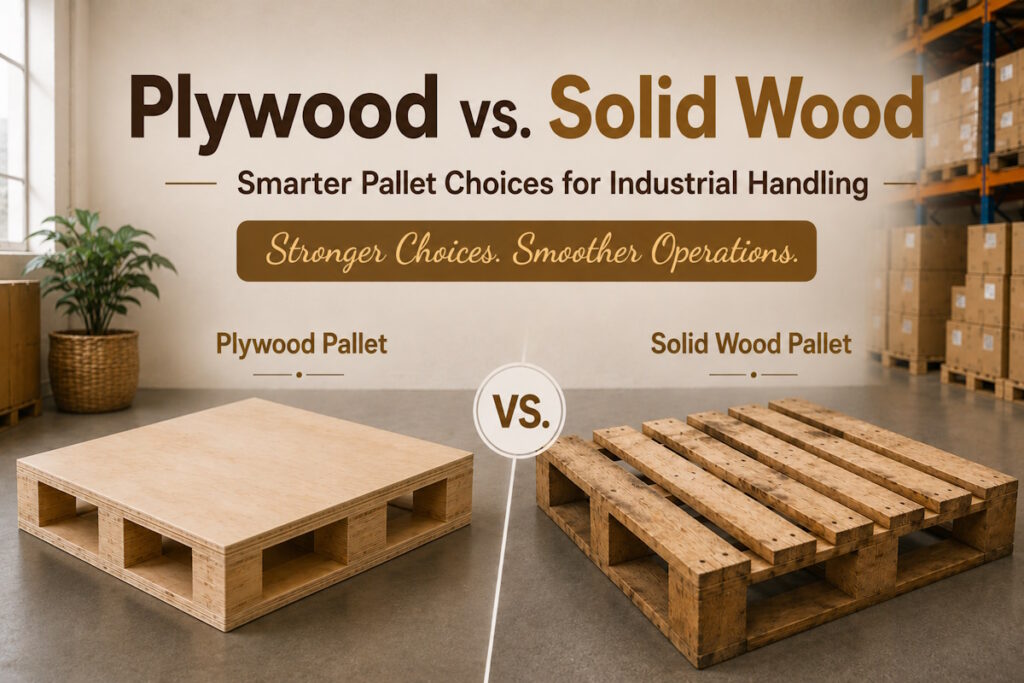
Understanding Industrial Pallet Requirements
In the world of logistics and supply chain management, the choice of shipping platform is often overlooked, yet it remains a primary factor in shipping costs and product safety.
Industrial material handling demands consistency, strength, and compliance with international transport regulations.
Whether you are moving light consumer goods or heavy machinery, the foundation of your cargo matters significantly.
The debate between plywood pallets and traditional solid wood pallets persists because each material offers distinct mechanical advantages. While solid wood has been the industry standard for decades, modern manufacturing requirements are shifting toward engineered wood solutions, including plywood and custom wood pallets designed for specific handling and shipping requirements.
Not sure whether plywood or solid wood pallets are right for your operation?
The Case for Plywood Pallets in Modern Logistics
Structural Uniformity and Weight
Plywood pallets are engineered products, meaning their strength is consistent across the entire surface. Unlike solid wood, which may have natural knots, splits, or moisture-related warping, plywood offers a uniform density. This is crucial for automated handling systems where consistent dimensions are required to prevent conveyor jams or sensor errors.
Furthermore, plywood is significantly lighter than solid timber. In an industry where freight costs are calculated based on both volume and weight, reducing the dead weight of the pallet can lead to substantial savings over thousands of shipments. High-quality plywood manufacturers in India now produce lightweight, high-density variants specifically designed to balance portability with structural integrity.
Consistency in Automated Handling
Automated warehouses rely on standardized dimensions. Plywood does not shrink or expand as drastically as solid wood when exposed to changing humidity levels. This stability ensures that the pallet remains within tolerance, reducing the risk of downtime in automated retrieval systems.
Need custom pallet dimensions or load-bearing specifications?
Compliance and ISPM 15 Standards
One of the most significant advantages of plywood over solid wood is its regulatory status. Solid wood pallets intended for international export often require heat treatment or chemical fumigation to meet ISPM 15 standards, intended to prevent the spread of invasive pests. Because plywood is manufactured using high-pressure and heat-bonding adhesives, it is generally considered processed wood and is often exempt from these stringent quarantine requirements.
Evaluating Solid Wood for Heavy-Duty Applications
Load-Bearing Capacity and Repairability
Solid wood remains the preferred choice for extremely heavy industrial applications. The natural fibrous structure of solid timber allows it to withstand significant impact and high-point loads without suffering the delamination risks associated with lower-quality plywood. If your operation involves heavy metallic components or raw materials, the sheer rigidity of solid wood is hard to replicate.
Additionally, solid wood pallets are easily repaired. If a single slat breaks, it can be replaced on-site with simple tools. Plywood, while durable, is generally a single-piece platform that is less conducive to component-level repair.
Environmental and Manufacturing Factors
Natural Material Variability
When sourcing from wooden pallet manufacturers, it is important to note that solid wood quality depends heavily on the timber species and local environmental conditions. Variations in moisture content can lead to mold growth if not properly managed, which poses a risk to sensitive cargo such as pharmaceuticals or electronics.
For businesses concerned about consistent quality, choosing engineered plywood solutions often removes the variability inherent in traditional sawmill products. Get factory-direct pricing for premium materials that ensure your goods reach their destination safely.
Choosing the Right Solution for Your Business
Factors Influencing Your Decision
The decision to switch from solid wood to plywood should be based on your specific logistics workflow. If you are shipping via air freight, the weight reduction offered by plywood is a major advantage. If you are shipping via land or sea and require high-impact resistance for heavy machinery, solid wood may continue to be your primary choice.
Consider the total cost of ownership. While solid wood may have a lower initial price point, the hidden costs of international compliance, mold management, and product damage due to moisture absorption can make plywood a more economical choice in the long run.
Consulting with Industry Experts
Before committing to a high-volume order, analyze your product’s weight distribution and the typical storage environment of your warehouses. We recommend consulting with professional teams who understand both timber properties and engineered plywood standards.
Ready to upgrade your material handling operations?