
Selecting the correct material dimension is often the difference between furniture that endures decades of daily use and panels that sag, warp, or fail under pressure.
When planning interior layouts, wardrobe carcases, modular kitchens, or architectural woodwork, material sizing requires careful evaluation of structural loads, span lengths, and daily handling intensity.
Misjudging material dimensions can lead to structural weakness in heavy load applications or unnecessary structural dead weight and inflated material costs in lighter fixtures.
Every interior application demands specific structural calculations based on how weight is distributed across the panel surface. Whether you are building kitchen wall units, heavy storage shelving, or structural partitions, understanding standard dimensional options helps you specify accurately. This comprehensive plywood thickness guide explores how to match material dimensions to your exact structural requirements, ensuring optimal performance across residential and commercial projects.
Understanding Standard Plywood Thickness Options and Manufacturing Norms
Plywood is manufactured by bonding multiple thin veneers of wood together under high pressure and temperature, with grain directions alternating at right angles for structural balance. This cross-laminated construction provides high dimensional stability across varying humidity levels. Standard manufacturing yields a specific range of dimensions designed to accommodate diverse structural applications in construction and interior fit-outs.
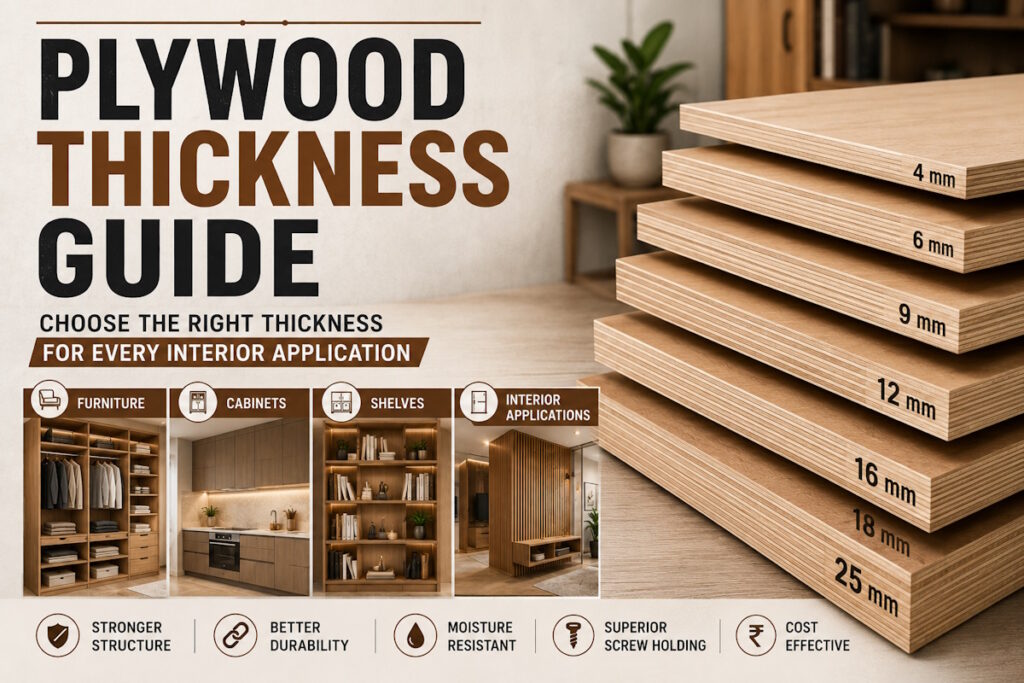
In Indian manufacturing and standard architectural specifications, material dimensions generally range from thin flexible panels up to heavy structural sheets. Common available sizes include 4 mm, 6 mm, 9 mm, 12 mm, 16 mm, 18 mm, and 25 mm. Each dimension serves a specific engineering purpose, governed by structural load-bearing capacity, resistance to bending, and screw-holding strength.
When evaluating standard plywood thickness in mm, buyers should note that nominal thickness can occasionally feature minor manufacturing tolerances depending on the core construction, veneer grading, and pressing pressure. Working with a reliable Plywood Supplier ensures that you receive material conforming to precise structural standards. It is always wise to measure actual panel thickness with a calibrated caliper before starting high-precision joinery work or modular assembly.
Plywood Thickness for Furniture and Structural Carcases
Furniture manufacturing requires careful balancing of weight, rigidity, and fastener retention. Wardrobes, study desks, bed frames, and commercial seating units experience distinct physical stresses depending on whether they act as stationary storage or dynamic furniture subjected to constant movement and heavy static loads.
For primary structural carcases, wardrobes, and heavy furniture units, 18 mm is the industry standard for main vertical partitions, horizontal shelves, and exterior outer frames. This dimension offers exceptional screw-holding capacity, allowing heavy hinges, drawer channels, and mounting brackets to anchor securely without loosening over time. Using thinner panels for main structural carcases often results in sagging under long-term loads or structural failure at joint connections.
For lighter furniture elements, backing panels, or drawer bottoms, thinner sheets are typically specified to reduce unnecessary dead weight. A 6 mm or 9 mm panel provides adequate stability for wardrobe backs and drawer bases when housed securely within routed grooves. For specialized architectural requirements where greater stability is needed without excessive weight, consulting a dedicated Best Plywood for Furniture guide helps clarify grade selection alongside dimensional planning.
Need guidance on selecting the right plywood thickness for your furniture project?
Plywood Thickness for Kitchen Cabinets and Modular Interiors
Modular kitchens represent one of the most demanding interior environments due to constant exposure to moisture, heat, steam, and heavy storage loads. Kitchen base cabinets support heavy stone or engineered quartz countertops, heavy cookware, and dense dishware, requiring rigorous structural planning during the material selection phase.
For kitchen base cabinets, tall pantry units, and sink units, 18 mm is mandatory for all outer carcases, inner vertical partitions, and fixed shelves. The top horizontal members of base cabinets must safely distribute countertop weight without deflecting. For upper wall cabinets, 18 mm is similarly recommended for side panels and structural hanging rails to ensure secure wall anchoring, while 12 mm or 16 mm is sometimes used for internal fixed shelving depending on the span length.
When designing modular kitchens, matching material dimensions with superior moisture-resistant bonding technology is critical. Pairing the right structural sizing with a comprehensive How to Check Plywood Quality evaluation ensures that your kitchen cabinetry withstands steam exposure, fungal decay, and heavy domestic usage without structural degradation.
Plywood Thickness for Shelving and Span Calculations
Shelf deflection is a common structural failure in custom joinery and bookcase design. When a shelf supports heavy books, files, or decorative artifacts, the material experiences continuous downward bending stress. If the panel is too thin or the span between vertical supports is too wide, permanent sagging occurs over time.
As a general rule, shelf thickness depends directly on the clear unsupported span length and the weight of the stored items. For light display shelves spanning up to 600 mm, a 12 mm or 16 mm panel may suffice. However, for heavy-duty bookshelves or wardrobe shelves spanning 900 mm or more, 18 mm or 25 mm is necessary to prevent long-term deflection. Where wider spans are architecturally required, incorporating intermediate vertical supports or utilizing alternative stable materials such as structured Block Board Supplier options can prevent bending under heavy static loads.
Evaluating load requirements before installation prevents costly restructuring later. For a deeper understanding of how structural dimensions interact with overall interior grades, reviewing a comprehensive Plywood Buying Guide provides valuable clarity on balancing thickness, core construction, and application environments.
Common Sizing Mistakes and How to Avoid Them
Specifying material dimensions involves avoiding several common pitfalls that compromise project longevity. One frequent mistake is overspecifying thin panels for heavy load applications in an effort to reduce material costs. While using 6 mm or 9 mm panels for structural shelving may lower initial expenses, it inevitably leads to catastrophic sagging, fastener pullout, and premature replacement costs.
Another widespread error is ignoring thickness variations across different manufacturing batches or unverified local suppliers. Inconsistent calibration during pressing can leave panels thinner at the edges than in the center, creating uneven joinery lines and weakened screw retention. Always verify that panels maintain uniform thickness across the entire sheet and conform to established industrial standards.
Finally, failing to account for finishing allowances can disrupt interior alignment. Remember that decorative laminates, wood veneers, or paint coatings add approximately 1 mm to 2 mm of total finished thickness to panel surfaces. When routing grooves for shutters, sliding tracks, or backing panels, carpenters must factor in these surface treatments to ensure smooth mechanical operation.
Selecting the Ideal Plywood Thickness for Your Specific Interior Project
Choosing the correct plywood thickness requires a systematic approach that weighs functional demands, load requirements, span distances, and environmental exposure. Prioritizing structural integrity over short-term cost savings ensures that your furniture, cabinetry, and architectural woodwork deliver lasting durability, aesthetic finish, and structural reliability.
Whether you are outfitting residential wardrobes, designing commercial office workstations, or executing large-scale institutional interiors, accurate material sizing protects your investment. Always verify structural requirements with qualified fabricators and source certified materials from trusted manufacturers who offer consistent calibration and reliable grade performance.
Planning a bulk interior project and need custom plywood thickness specifications?