
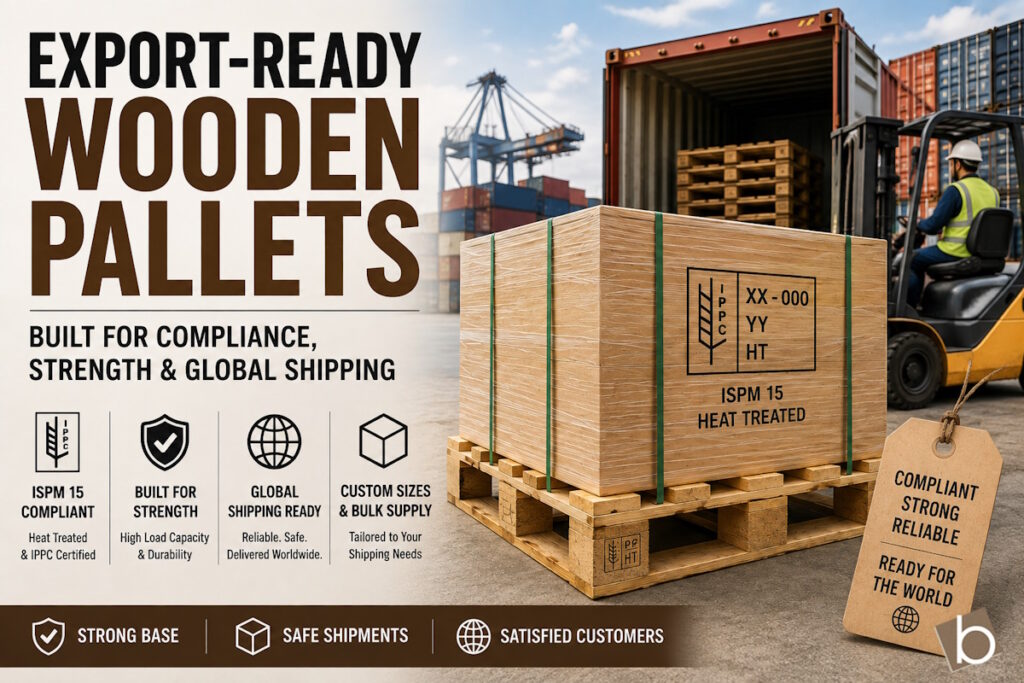
International shipping introduces rigorous demands on transport packaging that domestic transit rarely requires.
When cargo moves across borders, wooden platforms face unpredictable handling, fluctuating humidity levels, multi-modal transport stressors, and strict quarantine regulations.
International shipping introduces rigorous demands on transport packaging that domestic transit rarely requires. When cargo moves across borders, wooden platforms face unpredictable handling, fluctuating humidity levels, multi-modal transport stressors, and strict quarantine regulations. Selecting transport foundations without verifying technical parameters can result in customs delays, damaged cargo, rejected shipments at destination ports, or structural failure during transit. Sourcing dependable export wooden pallets requires a clear understanding of compliance mandates, timber quality, construction dimensions, and structural load calculations.
Every shipment relies on the structural integrity of its base platform to protect goods from handling damage and moisture exposure. Whether you are shipping heavy industrial machinery, bagged raw materials, or sensitive components, the packaging specification dictates whether cargo arrives intact. Working directly with an experienced Wooden Pallet Manufacturer ensures your transport bases match your exact weight, handling, and regulatory requirements without compromise.
Understanding ISPM 15 Compliance and Quarantine Mandates
The single most critical regulatory requirement for international shipping is compliance with International Standards for Phytosanitary Measures No. 15, commonly known as ISPM 15. This global standard regulates wood packaging material used in international trade to prevent the spread of plant pests and insects between countries. Without proper certification and marking, export shipments face severe penalties, fumigation at the port of entry, or outright rejection and mandatory return at the shipper’s expense.
ISPM 15 mandates that all timber packaging undergoes approved phytosanitary treatment to eliminate living organisms harbored within raw wood. When evaluating Heat Treated Wooden Pallets, buyers must verify that the timber has been processed according to official temperature and time schedules. The core temperature of the wood must reach a minimum of 56 degrees Celsius for a minimum duration of 30 minutes. This process sterilizes the timber without altering its structural strength.
Following approved treatment, compliant units must carry the internationally recognized IPPC stamp. This stamp includes the country code, a unique producer or treatment facility registration number, and the treatment code. For heat treatment, the code is HT. Buyers should never accept unbranded or improperly stamped timber for overseas shipping, as customs authorities inspect these markings rigorously at destination ports. Ensuring proper documentation from your supplier protects your supply chain from costly transit disruptions.
Evaluating Heat Treatment Versus Chemical Fumigation
While international phytosanitary regulations accept multiple treatment methods, heat treatment has become the preferred industry standard for global logistics. Understanding the difference between thermal processing and chemical alternatives helps procurement teams make informed decisions regarding cargo safety, environmental compliance, and material longevity.
Methyl bromide fumigation was historically common, but many countries have restricted or banned its use due to environmental and health concerns. Heat treatment offers a clean, chemical-free alternative that leaves no toxic residues on the wood surface. This is particularly important when shipping food products, pharmaceuticals, textiles, or consumer goods where chemical contamination could ruin entire consignments. Furthermore, heat-treated timber maintains better moisture equilibrium, reducing the risk of mold growth inside sealed containerized shipments.
When discussing specifications with Wooden Pallet Manufacturers, buyers should confirm their facility’s certification status and heating chamber capabilities. Certified manufacturers provide official treatment certificates that verify compliance with international plant protection conventions. This documentation is often required by freight forwarders and customs brokers before cargo acceptance.
Need heat treated export wooden pallets manufactured to your exact international shipping requirements?
Load Capacity Classifications and Structural Calculations
A frequent error in export packaging procurement is selecting units based solely on outer dimensions while ignoring load ratings. International transit exposes cargo to three distinct load states: static load, dynamic load, and racking load. Each state places different structural demands on the timber base.
Static load refers to the maximum weight the structure can support while resting stationary on a flat, even floor. This rating applies when loaded units are stacked inside a warehouse prior to container loading. Dynamic load defines the weight capacity while the unit is in motion, such as when being lifted, transported by a forklift, or moved across uneven terminal surfaces. Racking load represents the maximum weight the platform can support when placed in high-bay selective pallet racks without bottom support.
Buyers must calculate total cargo weight and account for dynamic forces experienced during ocean freight or road transport. Heavy industrial shipments require robust stringer or block designs, adequate board thickness, and proper fastener placement to prevent structural splitting under stress. For specialized heavy cargo, consulting with a qualified Plywood Manufacturer or timber engineer can also help determine if engineered wood components or reinforcement panels are necessary for top-deck load distribution.
Selecting Pallet Types and Construction Designs
Choosing the correct design configuration depends on your handling equipment, warehouse automation, and destination country logistics. Different Wooden Pallet Types offer distinct advantages regarding forklift entry, strength, and stackability.
Two-way entry platforms allow fork tines to enter from two opposite sides, offering high structural strength and simple stringer construction. Four-way entry platforms allow forklift and pallet jack access from all four sides, maximizing handling efficiency in tight container spaces and automated distribution centers. For international shipping, four-way entry is often preferred because it simplifies loading patterns inside standard 20-foot and 40-foot dry containers.
Buyers must also choose between stringer boards and block designs. Stringer designs use parallel support boards beneath the top deck, whereas block designs use solid wooden corner and center blocks connected by perimeter boards. Block designs generally provide superior load distribution and multi-directional handling capability, making them ideal for heavy global freight.
Looking for custom export pallet specifications designed for your heavy cargo and container shipping needs?
Timber Species, Moisture Content, and Quality Control
The underlying raw material quality dictates how well transport platforms withstand long-distance shipping environments. Hardwoods and softwoods both serve in international logistics, but each brings distinct density, weight, and fastening characteristics.
Moisture content is a critical quality parameter. Green timber contains high moisture levels that can lead to fungal staining, warping, and condensation inside sealed shipping containers. Container sweat, caused by temperature fluctuations during ocean transit, can combine with excess wood moisture to ruin corrugated packaging and damage goods. Export platforms should utilize kiln-dried or properly seasoned timber to maintain optimal dimensional stability and prevent mold proliferation.
Inspection protocols should verify timber grade, checking for excessive knots, cross-grain weaknesses, bark remnants, and insect galleries. Even heat-treated timber that retains bark can fail quarantine inspections in strict jurisdictions like Australia, New Zealand, and the United States. Working with established manufacturing partners ensures rigorous quality control at every stage of production.
Common Procurement Mistakes to Avoid in Export Packaging
Navigating international supply chains requires avoiding common specification pitfalls that compromise cargo safety and inflate shipping costs. Many businesses treat transport bases as an afterthought rather than a critical engineered component of their logistics strategy.
One common mistake is assuming standard domestic dimensions fit all international markets. While global standards exist, regional preferences vary. For example, shipments destined for European markets often utilize specific Euro dimensions, whereas North American supply chains favor standard 48×40 inch configurations. Mismatched dimensions lead to inefficient container space utilization and shifting cargo.
Another frequent error is underestimating fastener quality. Nails used in export construction must have sufficient holding power and corrosion resistance. Smooth shank nails can back out under vibration during ocean transit, causing deck boards to loosen. Using annular-threaded or spiral nails ensures superior withdrawal resistance and structural rigidity throughout the journey.
Choosing the Right Partner for Bulk Export Requirements
Securing a reliable supply of compliant transport platforms is essential for businesses engaged in regular international trade. Procurement teams must look beyond initial unit pricing and evaluate manufacturing capability, quality assurance systems, and delivery reliability.
Partnering with a trusted direct manufacturer ensures consistent adherence to ISPM 15 standards, precise dimensional tolerances, and dependable bulk fulfillment. Transparent communication regarding load requirements, destination regulations, and delivery timelines prevents costly logistical errors. Evaluating supplier credentials and requesting sample inspections before placing large orders safeguards your global supply chain from compliance failures.