
Evaluating wood pallet load capacity before placing a bulk order is one of the most critical steps in industrial supply chain management.
Many businesses mistakenly focus solely on outer dimensions and board thickness while overlooking how a pallet handles weight under different operational conditions.
A structure that performs reliably on a flat warehouse floor can fail catastrophically when lifted by a forklift or placed across high tier racking beams.
Understanding how weight limits interact with real-world handling methods prevents costly product damage, workplace safety hazards, and premature packaging failures.
Industrial buyers, logistics managers, and procurement teams must analyze multiple performance metrics rather than relying on generalized weight ratings. Wood species, moisture content, fastener placement, stringer configuration, and deck board thickness all influence structural integrity. Whether you are sourcing packaging for domestic freight or international distribution, partnering with an experienced Wooden Pallet Manufacturer ensures your specifications align precisely with your operational demands and safety requirements.
Defining Wood Pallet Load Ratings
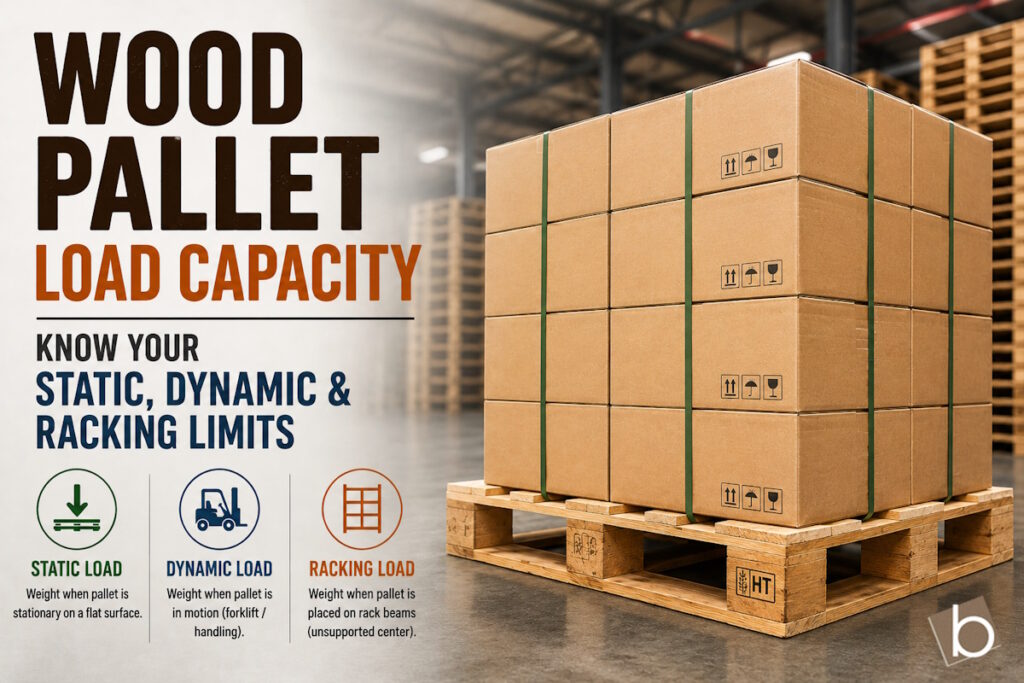
Wood pallet load rating refers to the maximum weight a platform can safely support under specific handling and storage conditions. Load capacity is never a single universal number. Instead, it is divided into three distinct operational categories that reflect how the pallet is used throughout its lifecycle. Confusing these categories is the most common cause of structural failure in transit and storage facilities.
When manufacturers test wood pallet load capacity, they measure how the deck boards, stringers, or blocks distribute weight across support surfaces. A pallet that holds a massive static weight in a stationary stack may lack the structural rigidity required for dynamic movement or unsupported racking spans. To make an informed purchasing decision, buyers must look beyond nominal dimensions and evaluate the exact mechanical stresses the platform will face from factory floor to final destination.
Static Load Capacity Explained
Static load capacity represents the maximum weight a wooden pallet can support when it rests on a flat, even surface and remains completely stationary. This scenario occurs when loaded pallets are stacked on top of one another in a warehouse or storage bay. Because the weight is distributed evenly downward without movement, static capacity is always the highest rating assigned to a pallet design.
When calculating static capacity, the bottom pallet in a stack bears the weight of every unit placed above it. If four loaded pallets are stacked vertically, the bottom unit must support its own load plus the combined weight of the three units resting on top. Exceeding this limit causes deck boards to crack, bottom blocks to crush, and the entire vertical stack to destabilize. For businesses storing heavy inventory, verifying static ratings helps optimize floor space safely without risking sudden structural collapse.
Dynamic Load Capacity Requirements
Dynamic load capacity measures the maximum weight a pallet can safely support while it is actively in motion, typically when being lifted, transported, or maneuvered by a forklift or pallet jack. During transit, sudden stops, tight turns, floor irregularities, and lifting vibrations create mechanical stress that significantly reduces the safe weight limit compared to a static environment.
A pallet rated for heavy static loads may experience severe deflection under dynamic conditions if the deck boards are too thin or if the fasteners loosen during handling. When forklifts insert tines into pallet entries, the entire weight of the cargo rests on specific points of the deck and stringer assembly. Selecting appropriate New Wood Pallets for Heavy Loads ensures that dynamic handling forces do not cause board separation or nail withdrawal during active transport cycles.
Racking Load Capacity in High Bay Storage
Racking load capacity is the most demanding rating for any industrial wood platform. It defines the maximum weight a pallet can support when placed across open pallet rack beams where the center of the platform is completely unsupported. In high bay warehouses, the entire load must be bridged safely between front and rear support beams without sagging or structural failure.
When a loaded pallet sits in a rack, gravity pulls the center downward, placing intense tensile stress on the bottom deck boards and stringers. If the wood lacks sufficient thickness or if the stringer notches are cut too deep, the pallet will bow dangerously. In severe cases, unsupported racking loads cause pallets to slip between rack beams, endangering workers and destroying valuable inventory. Buyers operating modern high-bay facilities must prioritize racking ratings above all other metrics when selecting heavy duty packaging.
Need help determining the right wood pallet load capacity for your warehouse?
How Construction and Materials Influence Pallet Weight Limits
The physical construction of a wooden platform dictates its overall performance and weight threshold. Two pallets of the exact same outer dimensions can have vastly different load capacities based on wood density, fastener quality, and structural design. Evaluating these construction elements helps buyers avoid underspecified packaging that fails prematurely under rigorous industrial use.
Industrial manufacturing standards require careful selection of timber species and board dimensions. While softwoods like pine are common for standard utility applications, hardwoods are frequently specified for extreme industrial weight requirements. Understanding how stringer boards, block designs, and deck configurations interact with wood density ensures that your packaging investments deliver reliable, long-term performance across demanding supply chains.
Stringer Versus Block Pallet Designs
The internal framework of a wooden platform determines how weight is transferred to the floor or forklift tines. Stringer pallets use solid longitudinal boards running the length of the structure, providing linear support and clear entry points for handling equipment. These designs are efficient for standard two-way or four-way entry applications and offer reliable load distribution when manufactured with appropriate timber thickness.
Block pallets utilize a more complex matrix of solid wood blocks and perpendicular boards, allowing true four-way forklift entry. This design enhances maneuverability in tight warehouse aisles and typically provides superior rigidity for heavy multi-directional handling. Selecting between these structural styles depends heavily on your material handling equipment, warehouse layout, and whether your operations require high-capacity Wooden Pallet Types built for rigorous industrial environments.
Fastener Quality and Timber Density
The hardware holding a pallet together plays just as vital a role as the wood itself. Spiral nails, annular ring shank nails, and heavy-gauge staples provide the withdrawal resistance necessary to withstand the constant vibrations and mechanical stresses of dynamic transport. Smooth-shank nails often back out under vibration, causing the structure to loosen and lose its designed load capacity.
Timber density also dictates structural strength. Denser wood species resist crushing under heavy point loads and hold fasteners more securely than lighter woods. However, denser timber increases overall packaging weight, which can impact freight costs for outbound shipments. Balancing wood density with required load ratings is a critical consideration for procurement teams managing shipping efficiency.
Matching Pallet Specifications to Industry Applications
Different industrial sectors impose unique demands on wooden platforms. A pallet transporting bagged chemicals requires different specifications than one carrying delicate electronics or heavy automotive components. Analyzing your specific application ensures that your packaging investment matches actual operational exposure without unnecessary overspending.
When procuring packaging for specialized sectors, buyers must consider environmental exposure, moisture levels, handling frequency, and distribution channels. Custom manufacturing allows businesses to tailor board counts, thickness, and fastener patterns to match unique product footprints. Consulting with a specialized Large Wooden Pallets supplier ensures that oversized or heavy cargo receives the structural support required for safe transit.
Heavy Machinery and Industrial Equipment Sourcing
Transporting heavy machinery, metal coils, or industrial hardware requires robust platforms engineered to withstand extreme point loads. Standard commercial pallets quickly fail when subjected to localized heavy weights that concentrate stress on a small surface area. In these scenarios, thick top decking, reinforced stringers, and custom skid designs are mandatory.
Procurement managers should request engineered drawings and tested load verifications from their manufacturer before finalizing bulk orders for heavy equipment transport. Ensuring that the platform can absorb impact shock during loading and unloading prevents catastrophic failures that can damage expensive machinery and halt project timelines.
Warehousing, Racking, and Automated Storage Integration
Modern automated storage and retrieval systems place rigorous demands on wooden platforms. Automated conveyors, roller tracks, and high-tier racking systems require precise dimensional consistency and high structural rigidity. Even minor warping or board deflection can cause automated equipment jams or alignment errors in high-speed fulfillment centers.
Facilities utilizing high-bay racking must ensure that pallets maintain their structural integrity over extended periods under continuous tensile stress. Regular inspection protocols combined with high-grade timber construction prevent accidents and maintain smooth, uninterrupted workflow across automated distribution hubs.
Looking for custom wooden pallets engineered for heavy industrial loads?
Common Mistakes to Avoid When Evaluating Pallet Weight Limits
Purchasing industrial packaging without a clear understanding of load ratings frequently leads to operational inefficiencies and safety incidents. Recognizing common specification errors helps buyers protect their inventory and optimize supply chain performance.
Many organizations make purchasing decisions based exclusively on initial unit price rather than structural suitability. This approach often results in damaged goods, rejected shipments, and higher long-term replacement costs. Reviewing standard procurement pitfalls ensures your team makes informed, reliable purchasing decisions.
Ignoring Dynamic and Racking Stress Factors
A frequent error is assuming that a pallet capable of holding a heavy weight on a flat floor will perform identically when lifted by a forklift or placed in a rack. Failing to account for dynamic vibrations and unsupported racking spans invites structural failure during transit. Always verify that the pallet rating matches the most demanding phase of its operational journey.
Overlooking Wood Moisture Content and Environmental Exposure
Green or unseasoned timber contains high moisture levels that make wood heavier and more susceptible to warping, shrinkage, and fungal growth as it dries. Furthermore, wet wood holds fasteners less securely, reducing the overall load rating. For export shipping and sensitive storage environments, kiln-dried timber provides superior dimensional stability and consistent load performance.
Neglecting Product Distribution and Point Load Concentration
Distributed loads spread weight evenly across the entire surface of the platform, while point loads concentrate heavy weight onto specific areas. Placing a heavy, rigid steel crate on a pallet creates intense localized stress that can break thin deck boards even if the total weight is below the stated pallet capacity. Always analyze how your cargo contacts the deck surface before finalizing specifications.
Choosing the Right Wood Pallet Specifications for Your Project
Selecting the ideal wooden packaging for your operations requires careful alignment between cargo weight, handling methods, storage conditions, and budget. Working closely with an established manufacturer ensures your specifications meet all regulatory and operational demands without unnecessary expenditure. Plywood India delivers factory-direct wooden platforms, industrial skids, and engineered wood solutions designed to support your exact load requirements.
Before requesting a bulk quotation, document your maximum static weight, dynamic handling requirements, racking conditions, and environmental exposure. Clear communication of these parameters enables engineering teams to recommend or custom-build platforms that safeguard your supply chain. For complementary interior and structural woodworking needs, explore our premium range of materials available through our primary Plywood Manufacturer catalog.