
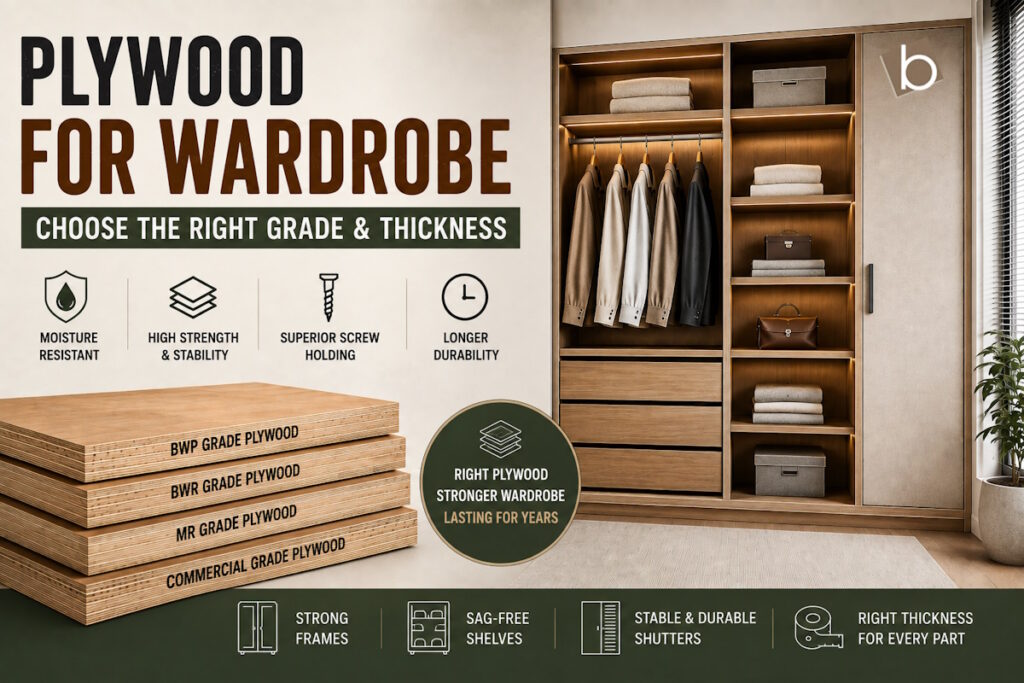
Designing a custom wardrobe requires a careful evaluation of internal structural loads, door spans, and environmental humidity levels.
Selecting the appropriate plywood for wardrobe construction directly determines whether your furniture remains rigid over years of daily use or begins to warp, sag, or fail at the joints.
Many builders and homeowners focus entirely on exterior laminates or veneers while overlooking the underlying core material, which leads to structural issues shortly after installation.
Understanding how different grades, thicknesses, and core constructions perform across wardrobe frames, internal shelving, and hanging shutters prevents costly replacements and ensures lasting functionality. Whether you are consulting with a Plywood Manufacturer for a large residential project or specifying materials for a single bedroom wardrobe, aligning your material choices with mechanical requirements is essential for successful interior joinery.
Evaluating Wardrobe Plywood Grades for Structural Performance
The grade of engineered wood you select dictates its resistance to moisture, humidity, and delamination. Wardrobes installed in residential bedrooms, dressing rooms, or utility areas experience varying environmental conditions. Choosing the correct wardrobe plywood grade ensures that seasonal humidity shifts do not compromise the structural integrity of the entire cabinetry assembly.
Commercial grade plywood, often referred to as MR or Moisture Resistant grade, is bonded with urea-formaldehyde resins. While suitable for dry interior shelving that never encounters direct water exposure, it lacks the bonding durability required for structural frames in humid regions or areas prone to dampness. For wardrobe frames that anchor heavy sliding or hinged doors, engineers and interior designers generally specify boiling water resistant or boiling waterproof grades bonded with melamine-urea-formaldehyde or synthetic phenol-formaldehyde resins.
When sourcing materials for home interiors, reviewing resources like the guide on the Best Ply for Home Furniture helps clarify where moisture resistance is truly necessary. While you may not need exterior-grade panels for every internal divider, using moisture-resistant panels for bottom base units and wall-anchored frames prevents long-term degradation from floor cleaning and seasonal humidity fluctuations.
Determining the Right Plywood Thickness for Wardrobe Frames and Carcasses
The structural skeleton of any wardrobe must support the weight of internal partitions, hanging clothes, drawers, and heavy shutters. Selecting the correct plywood thickness for wardrobe carcass construction prevents structural twisting and ensures secure hardware fastening. Thin panels often fail to hold screws securely under the dynamic load of opening and closing doors.
Main outer frames, vertical partitions, and structural internal dividers typically require panels that offer high screw-holding capacity and rigidity. Thicker panels distribute load evenly across wall mounts and floor supports. In contrast, back panels can utilize thinner sheets since they serve primarily as space enclosures rather than load-bearing structural members. However, relying on excessively thin panels for primary vertical supports compromises the entire furniture assembly.
When evaluating panel integrity, checking for High Quality Plywood construction with minimal internal core gaps ensures that screws bite into solid wood rather than empty space. Panels with overlapping internal veneers or gaps suffer from reduced screw-holding strength, causing hinges and brackets to loosen over time.
Need help selecting the right plywood thickness and grade for your wardrobe frames?
Engineering Plywood for Wardrobe Shelves to Prevent Sagging
Wardrobe shelves bear concentrated static loads from folded garments, storage boxes, and heavy woolens. Plywood for wardrobe shelves must resist deflection over extended spans. When a shelf lacks adequate thickness or internal structural stiffness, it bends downward in the middle, distorting the shelf layout and placing stress on side partitions.
The allowable span of a shelf depends directly on its thickness and core composition. Standard wardrobe shelves spanning between thirty inches and forty inches require robust panel thickness to prevent visible bowing under heavy loads. In wider wardrobe compartments, many cabinet makers choose specialized engineered wood alternatives such as those from a trusted Block Board Manufacturer for wide shelves, as block board cores featuring solid wood strip centers offer superior resistance to bending over long horizontal spans compared to standard layered panels.
When comparing panel options detailed in resources discussing the Best Plywood for Furniture, consider the weight density of the items you plan to store. Heavy books or dense storage bins require thicker, high-density panels, whereas lighter clothing shelves can utilize standard interior configurations without risking structural deflection.
Selecting Plywood for Wardrobe Shutters and Door Stability
Wardrobe shutters are subjected to continuous movement, torsional stress, and physical impact. Whether you are designing full-height hinged doors or wide sliding panels, choosing the right plywood for wardrobe shutters is critical for maintaining alignment and preventing door warping.
Tall wardrobe shutters are particularly vulnerable to warping caused by seasonal changes in ambient temperature and humidity. Using thinner panels for doors taller than six feet almost always results in bowing, which prevents doors from closing flush against the cabinet frame. Shutters require stable, balanced panel construction with uniform core veneers to counteract internal stresses. Additionally, heavier shutters place immense downward force on hinges and sliding tracks, making screw retention a primary specification factor.
For sliding wardrobe configurations, straightness and dimensional stability take precedence over raw weight. Selecting calibrated panels ensures uniform thickness across the entire surface, allowing tracks, channels, and soft-close mechanisms to operate smoothly without binding or catching against the cabinet carcass.
Common Specifications and Mistakes to Avoid When Buying Wardrobe Plywood
Purchasing materials for custom joinery often involves navigating conflicting advice regarding cost, brand names, and technical specifications. Avoiding common specification errors ensures your investment yields durable furniture that requires minimal maintenance over its lifecycle.
One frequent mistake is mixing low-grade commercial panels into high-moisture zones such as wardrobe bases located near exterior walls or bathrooms. Another error is neglecting edge banding and sealing, which allows ambient moisture to penetrate internal core layers and cause localized swelling. Buyers also frequently underestimate the impact of hardware weight on thin shutter panels, leading to torn hinges and sagging doors within months of installation.
When procuring materials for larger residential or commercial interior projects, verifying manufacturing standards, core veneer uniformity, and thickness calibration with your supplier ensures consistent performance. Factory-direct procurement allows project buyers and contractors to obtain customized thicknesses and certified grades tailored precisely to the architectural drawings of the space.
Looking for factory-direct wardrobe plywood and custom panel specifications for your project?
Making the Right Plywood Choice for Your Wardrobe Project
Selecting the ideal plywood for wardrobe construction requires balancing structural strength, moisture exposure, shelf span requirements, and shutter dimensions. Prioritizing certified moisture-resistant grades for structural carcasses, robust thicknesses for heavy shelves, and stable, calibrated panels for tall shutters ensures your finished cabinetry withstands daily mechanical wear and environmental shifts.
Evaluating your storage needs before purchasing materials prevents both over-specification and structural failure. By focusing on core density, screw-holding capacity, and balanced panel construction, architects, interior designers, and homeowners can achieve professional, long-lasting results. Plywood India supports residential and commercial projects with comprehensive manufacturing expertise and factory-direct supply options tailored to exact engineering specifications.