
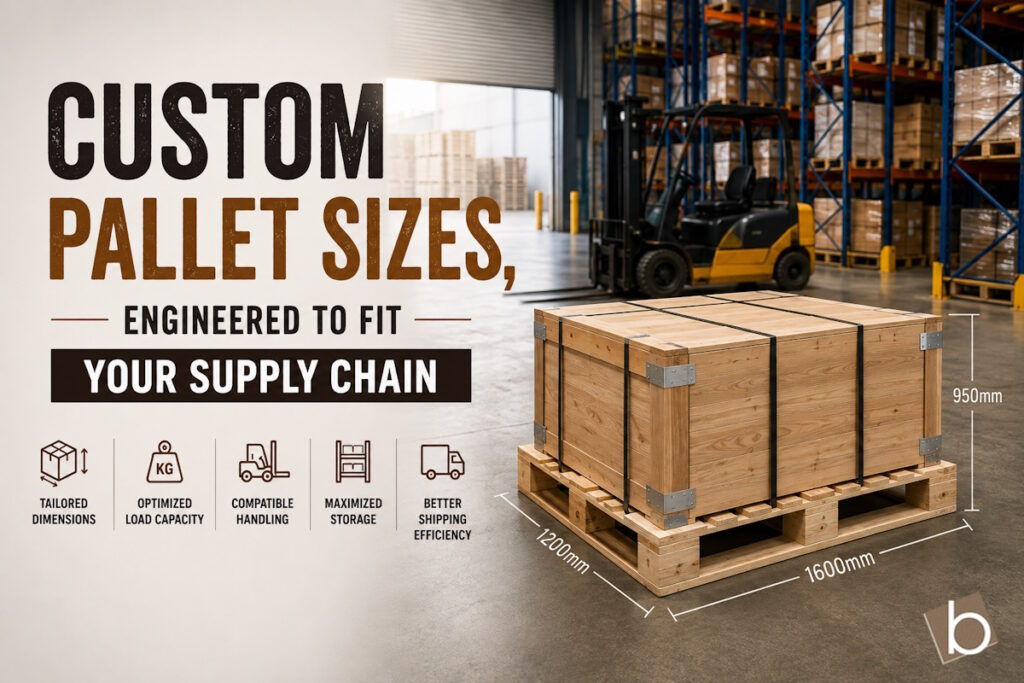
When goods move through a supply chain, the platform they rest upon dictates the efficiency of handling, storage, and transport.
While standard dimensions dominate general warehousing, many industrial operations involve cargo that does not fit conventional footprints.
Relying on standard platforms for oversized, irregularly shaped, or extremely heavy items often leads to wasted container space, product overhang, and structural instability during transit.
Procuring units tailored to specific operational realities ensures that cargo remains secure from the warehouse floor to its final destination.
Choosing the correct custom pallet sizes requires a careful analysis of manufacturing specifications, warehouse racking limitations, and logistics constraints. Plywood India works closely with industrial clients to engineer reliable material handling solutions, operating as an established Wooden Pallet Supplier dedicated to meeting exact industrial demands. Understanding how dimensions, load capacities, and handling equipment interact allows procurement teams to make informed decisions that protect goods and optimize shipping costs.
Evaluating Product Dimensions and Cargo Footprints
The foundation of any successful pallet specification begins with the physical dimensions of the goods being transported. When products are placed on a platform, the footprint must accommodate the cargo without excessive overhang or underutilized surface area. Product overhang can lead to edge crushing when units are stacked or wrapped, while excessive empty space reduces container loading efficiency and increases freight costs.
Engineers and packaging specialists must evaluate whether items require a flush design where the deck boards align with the stringers or blocks, or a single overhang design to accommodate specific strapping or stretch wrapping equipment. For businesses exploring specialized configurations, reviewing insights on Custom Wood Pallets helps clarify how unique product geometries influence overall design choices. Furthermore, when dealing with compact or dense items, opting for Small Wooden Pallets can drastically improve floor space utilization inside tight warehouse aisles and transport vehicles.
Balancing Surface Area and Weight Distribution
Surface area dictates how weight is distributed across the deck boards and stringers. A wider platform spreads static weight more evenly, reducing pressure points that could damage sensitive goods. However, increasing dimensions beyond what is necessary adds unnecessary tare weight to shipments, which drives up freight expenses over time.
When designing custom wooden pallet dimensions, manufacturers evaluate the center of gravity of the loaded unit. Uneven weight distribution requires strategic board spacing and reinforcement to prevent the platform from sagging or twisting under heavy loads. Procuring units with precise board layouts ensures that heavy machinery components or bagged materials rest securely without shifting during transit.
Managing Perimeter Clearance and Shrink Wrapping
Another critical factor in sizing is the clearance needed for packaging materials. If stretch film or strapping bands must pass around the base and over the top of the cargo, the platform dimensions must account for this extra thickness. Failing to leave adequate perimeter clearance makes automated wrapping difficult and often results in loose packaging that fails during long-haul transport.
Manufacturing facilities also need to consider how the product interacts with internal container walls. Tailoring dimensions to fit snugly inside standard shipping containers or delivery trucks eliminates dead space and prevents cargo from sliding during sudden braking or sharp turns.
Need custom pallet sizes engineered around your exact product dimensions and shipping requirements?
Matching Pallet Dimensions to Material Handling Equipment
A platform can support the weight of a product perfectly, but if it is incompatible with the warehouse material handling equipment, it causes operational bottlenecks. Forklifts, pallet jacks, stackers, and automated conveyor systems all impose strict geometric requirements on the base structures they lift and transport.
Before finalizing any custom shipping pallets, procurement teams must verify fork pocket spacing, entry height, and clearance levels. If the spacing between stringers or blocks does not match the tine spread of the facility equipment, operators cannot safely lift the load, increasing the risk of dropped goods and workplace injuries.
Forklift and Pallet Jack Compatibility
Two-way and four-way entry options change how handling equipment approaches a load. Four-way entry platforms allow forks to enter from any side, which greatly improves maneuverability in cramped loading docks and congested warehouse aisles. Two-way entry units limit access to opposing sides, requiring more precise alignment by forklift operators.
When pallet jacks are used extensively for internal movement, the design must feature chamfered bottom boards or notched stringers to allow wheels to roll smoothly in and out without damaging the structure. Exploring various Wooden Pallet Designs provides clear examples of how notch placement and entry configurations support efficient warehouse operations.
Automated Conveyor Systems and Roller Integration
Modern distribution centers rely heavily on automated conveyors and gravity rollers to sort and move inventory. These systems depend on consistent bottom deck coverage to prevent boards from catching on rollers or jamming transfer junctions.
When custom dimensions are introduced into an automated environment, the bottom deck board orientation must align with the direction of the roller travel. Perpendicular boards prevent sagging between rollers, ensuring smooth, uninterrupted movement through sorting lines and automated storage and retrieval systems.
Accounting for Storage Systems and Warehouse Racking
Warehouse storage density depends heavily on how platforms interact with pallet racking structures. Industrial pallet dimensions must match the depth and beam capacity of the racking system to prevent dangerous overhang or structural failure during high-tier storage.
When a unit sits inside selective racking, the front and rear deck boards must rest securely on the load beams. If the platform is too shallow, it can slip between the beams; if it is too deep, it may interfere with fire suppression sprinkler systems or block aisle space.
Static, Dynamic, and Racking Load Capacities
Load capacity is divided into three distinct categories that must be carefully calculated during the specification process:
- Static Load: The weight the platform can support when resting stationary on a flat floor.
- Dynamic Load: The weight capacity when the unit is being lifted and moved by a forklift or pallet jack.
- Racking Load: The maximum weight the structure can support when stored elevated in open pallet racks without bottom support.
Custom designs must be engineered to withstand the most demanding phase of their lifecycle. For instance, a platform that easily holds heavy goods on the warehouse floor may fail under racking loads if the stringers or top deck boards lack sufficient thickness or structural integrity.
Block Versus Stringer Construction for Heavy Loads
Choosing between block and stringer designs significantly affects load performance and handling versatility. Stringer designs use parallel solid wood members to support the deck boards, offering reliable strength for standard industrial applications. Block designs utilize solid wood blocks at the corners and center, providing superior rigidity and enabling true four-way entry for heavy-duty material handling.
For demanding export or heavy industrial applications, collaborating with an experienced Plywood Supplier or timber specialist ensures that the chosen core materials deliver the structural performance required for high-stress environments.
Looking for factory-direct custom wooden pallets built for your heavy storage and racking systems?
Common Specification Mistakes and How to Avoid Them
Specifying non-standard platforms requires attention to detail. Many procurement teams encounter costly setbacks simply due to overlooked operational variables during the design phase.
One frequent mistake is focusing solely on product dimensions while ignoring transport vehicle interior widths. A custom footprint that maximizes warehouse rack space may waste valuable square footage inside a shipping container, leading to higher per-unit freight costs. Evaluating the entire logistics chain from manufacturing plant to end-user helps eliminate these inefficiencies.
Another common error involves underestimating wood moisture content and environmental exposure. Pallets used for outdoor storage or international export face severe humidity and temperature fluctuations. Failing to specify heat-treated timber or appropriate protective treatments can lead to mold growth, structural warping, or rejection at international borders under ISPM 15 guidelines.
Finally, buyers sometimes compromise on board thickness to reduce upfront costs. Thin deck boards flex excessively under heavy point loads, leading to packaging damage and premature structural failure. Investing in robust material specifications reduces replacement frequency and protects valuable inventory throughout the supply chain.
Selecting the Right Pallet Dimensions for Your Operations
Choosing optimal custom pallet sizes is a strategic decision that directly influences supply chain efficiency, product safety, and operational costs. By carefully analyzing product footprints, material handling equipment, warehouse racking limitations, and load requirements, businesses can engineer platforms that perform reliably under demanding industrial conditions.
Effective procurement goes beyond matching basic measurements. It requires balancing deck board thickness, stringer placement, entry configurations, and material treatments to create a cohesive material handling asset. Taking the time to evaluate these variables ensures that your shipping operations run smoothly, safely, and cost-effectively.