
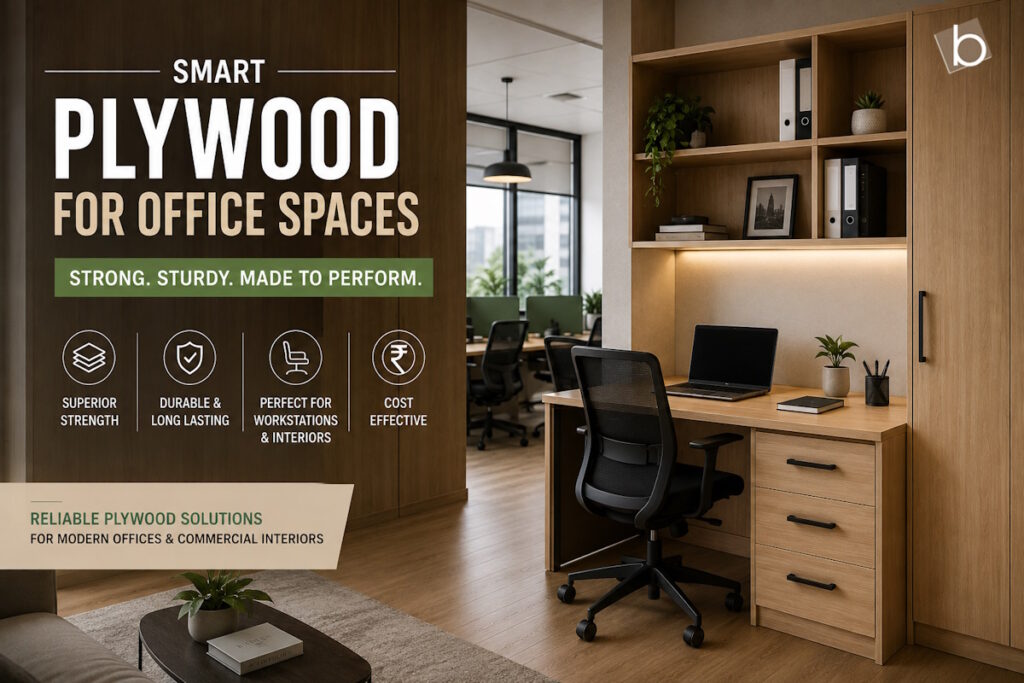
Commercial interior projects demand a level of material consistency and structural resilience that differs entirely from residential joinery.
Office desks, executive workstations, conference tables, and multi-tier storage cabinetry endure constant daily friction, high mechanical load, and repetitive handling from staff and visitors alike.
When specifying plywood for office furniture, procurement teams and interior designers must evaluate how core construction, bonding strength, and thickness tolerances influence long-term stability. Selecting an inadequate material grade or an inappropriate thickness often leads to sagging shelves, loose hardware, and structural failure within months of installation.
Evaluating material specifications before placing bulk orders ensures that corporate spaces maintain their functional integrity and aesthetic appeal over years of active use. Whether you are sourcing material as a furniture manufacturer or planning a corporate fit-out project, understanding the technical differences between interior panels and exterior-grade sheets prevents costly replacements. As an established Plywood Manufacturer, Plywood India works closely with project buyers to supply material engineered for demanding commercial environments. This guide breaks down the core parameters, grade selections, and application requirements necessary to make informed purchasing decisions for every workstation and commercial interior component.
Planning office furniture or a commercial fit-out?
Understanding Core Composition and Load Performance in Workstations
Modern office workstations require exceptional structural rigidity to support heavy desktop computers, multi-monitor setups, complex wiring channels, and daily mechanical loads. Unlike vertical wall paneling, horizontal surfaces like office desks and conference tables experience continuous downward pressure and occasional impact stresses. If the underlying core of the sheet contains internal gaps, overlaps, or low-density timber, the entire desk surface can flex, warp, or fail under concentrated weight.
Core composition directly dictates screw-holding capacity, which is a critical factor when installing sliding keyboard trays, cable management grommets, and heavy modesty panels. Premium commercial plywood features tightly packed core veneers bonded with synthetic resins to eliminate internal voids. When evaluating plywood for office desks, prioritize options that offer high dimensional stability and balanced construction. To explore how different panel grades perform across various joinery applications, review our insights on Best Plywood for Furniture.
Selecting panels with uniform thickness across the entire sheet ensures that edge-banding machinery and automated cutting saws achieve precise tolerances during mass fabrication. Contractors and furniture manufacturers should always inspect sample cross-sections to verify core density and veneer quality before approving large batch orders for corporate office projects.
Choosing Between BWR and MR Grades for Commercial Interiors
One of the most common specification decisions in corporate fit-outs involves choosing between moisture-resistant and boiling water-resistant adhesive bonding. While standard commercial interiors are generally protected from direct weather exposure, office environments still experience humidity fluctuations, routine floor cleaning with damp mops, and occasional accidental liquid spills around pantry units and breakout areas.
Boiling water-resistant plywood utilizes synthetic thermosetting resins that withstand moisture exposure without delaminating. This grade is essential for high-traffic zones, server rooms, cafeteria counters, and executive cabins where environmental conditions vary. On the other hand, interior moisture-resistant panels are often sufficient for dry vertical applications like low-stress partition framing or decorative wall cladding. Understanding the scope of Commercial Plywood Uses helps project managers allocate budgets effectively without compromising structural reliability in vulnerable areas.
When planning large office layouts, avoid the mistake of specifying maximum-grade exterior panels for every single low-risk partition. Conversely, never cut corners by using low-grade moisture-sensitive panels underneath heavy-duty reception counters or moisture-prone pantries. Balancing grade selection against actual environmental exposure optimizes project costs while ensuring long-term durability.
Need help selecting the correct plywood grade for your commercial interior project?
Thickness Selection for Office Desks, Tables, and Storage Cabinets
Getting thickness selection right is crucial for preventing structural sagging in commercial office furniture. Different components within an office layout demand specific gauge sizes to handle their intended loads safely. Using an overly thin sheet for a wide-span conference table leads to noticeable deflection in the middle, while overspecifying thickness for small drawer sides adds unnecessary weight and material costs.
For standard office desks and executive workstations, 18mm thickness is the industry benchmark for primary horizontal surfaces and structural modesty panels. This thickness provides adequate depth for secure hardware insertion, cam-lock fittings, and heavy fastening screws. For overhead storage cabinets and multi-shelf filing units, 12mm or 18mm panels are typically specified depending on the span length. If shelf spans exceed three feet without intermediate vertical partitions, 18mm panels are mandatory to prevent sagging under heavy paper files and binders.
Alternatively, for wide vertical partitions or lightweight core infills in modular cubicle systems, Block Board Manufacturer options provide excellent dimensional stability against bending across wide spans. Reviewing material specifications for Durable Plywood ensures that your chosen thicknesses align with both aesthetic requirements and heavy commercial usage demands.
Surface Finish, Face Veneer, and Laminate Compatibility
The exterior appearance of corporate furniture depends heavily on the face veneer quality of the underlying plywood. Commercial interiors require clean, smooth surfaces that accept high-pressure laminates, wood veneers, or specialized acrylic finishes without bubbling, telegraphing, or peeling over time. Uneven face veneers or internal core telegraphing can cause surface waves to appear after laminates are pressed, ruining the professional look of executive desks and boardroom tables.
When sourcing sheets for high-visibility reception areas and executive conference rooms, verify that the face veneer is free from major knots, splits, and overlapping splices. High-grade commercial plywood provides a uniform sanding finish that enhances adhesive bonding when laminating or veneering. Furthermore, balanced face construction on both sides of the sheet prevents warping caused by unequal moisture absorption after the laminate layer is applied.
Fabricators should also consider edge finishing requirements. High-density core construction ensures that when edges are trimmed and edge-banded with PVC or solid wood strips, the exposed sides remain clean and structurally sound without chipping or crumbling under routing tools.
Avoiding Common Mistakes in Commercial Furniture Procurement
Purchasing plywood for large-scale office projects involves navigating numerous technical pitfalls that can compromise project timelines and budgets. One frequent mistake is buying material based solely on initial price per square foot without verifying core density, thickness tolerance, or resin bonding quality. Low-cost panels often contain hidden core gaps that weaken screw retention, leading to loose hinges on filing cabinets and unstable desk legs within months.
Another common oversight is ignoring the specific environmental conditions of different zones within the office floor plan. For instance, pantry cabinetry and restroom vanity units require high-resistance bonding, whereas dry archive rooms require standard structural stability. Failing to specify the correct grade for each zone invites premature moisture damage and swelling.
Project buyers and contractors should always request material samples, verify manufacturer specifications, and confirm batch consistency before finalizing large wholesale orders. Establishing clear technical requirements with a reliable factory-direct supplier eliminates guesswork and ensures that every workstation, desk, and cabinet meets the rigors of modern commercial use.
Choosing the Right Plywood Specifications for Your Office Project
Specifying plywood for office furniture, workstations, and commercial interiors is a foundational decision that influences the durability, functionality, and professional appearance of any corporate workspace. By prioritizing core structural integrity, selecting appropriate adhesive grades for moisture exposure, matching panel thickness to load spans, and verifying face veneer quality, architects and project buyers can avoid premature furniture failure. Sourcing material from an experienced manufacturer ensures consistent thickness tolerances and reliable batch supply for projects of any scale.
If you are planning a corporate fit-out, upgrading executive workstations, or sourcing bulk materials for commercial furniture manufacturing, Plywood India offers factory-direct supply and expert technical guidance tailored to your project requirements.
Ready to source plywood for your office furniture or commercial interior project?