
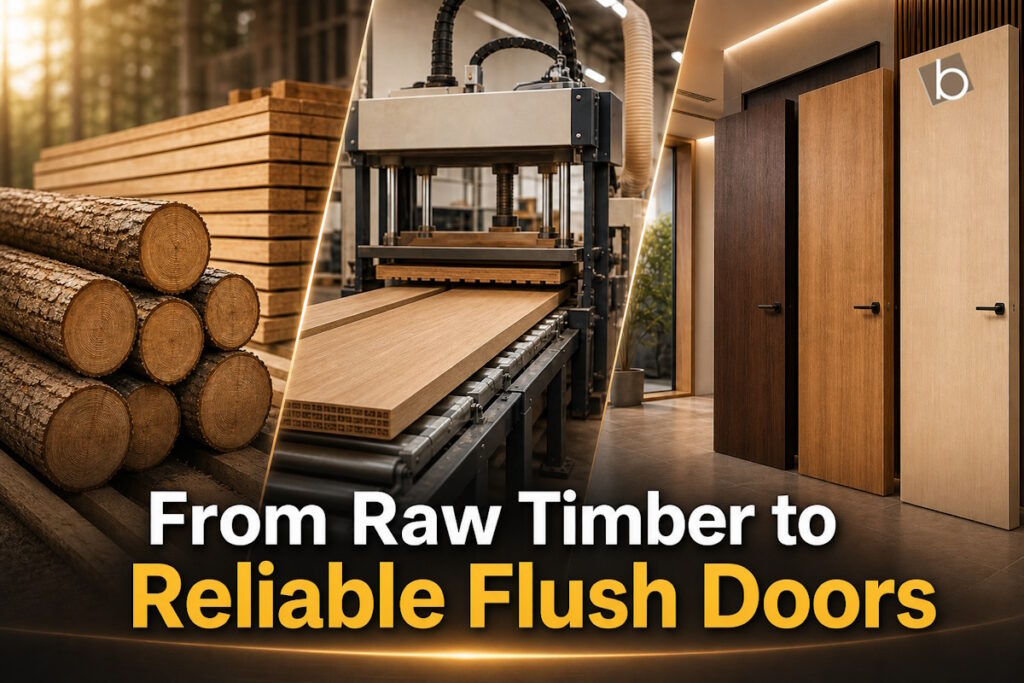
The Engineering Behind Quality Flush Door Manufacturing
A flush door is more than just a flat slab of wood; it is a complex engineered product designed to provide stability, sound insulation, and long-term durability.
In the Indian market, where climate fluctuations can severely impact wooden structures, the technical approach to flush door manufacturing defines its performance.
Whether you are a builder or an interior designer, understanding the internal construction is vital for ensuring that the doors you install remain warp-free and functional for years.
The manufacturing process begins with the selection of high-quality timber and core materials. Unlike solid wood doors, flush doors utilize a composite structure that balances strength with dimensional stability. At Plywood India, we focus on the synergy between the core, the cross-banding, and the face veneer. When these elements are engineered correctly, they resist the stresses of environmental moisture and temperature shifts, preventing common issues like delamination or bowing.
Need expert help selecting the right flush doors for your site?
Essential Raw Materials in Flush Door Production
The Importance of Core Composition
The core is the backbone of any flush door. Most manufacturers utilize seasoned timber or high-density engineered wood blocks arranged in a kiln-dried frame. The quality of this flush door raw material determines the door’s ability to hold screws, hinges, and locks securely. If the core contains voids or inconsistent density, the door will likely weaken over time under the weight of its own hardware.
Bonding Agents and Adhesive Standards
The integrity of a flush door relies heavily on the adhesive used during lamination. For exterior or high-moisture applications, synthetic resins—typically Phenol Formaldehyde (PF)—are preferred due to their excellent boiling water-resistant properties. The bonding process is not just about holding layers together; it is about creating a monolithic structure that acts as a single unit against physical stress.
The Role of Hot Press Technology
The hot press for flush door assembly is arguably the most critical stage in the manufacturing line. During this process, the assembled sandwich of core, veneer, and adhesive is subjected to precise temperatures and high pressure for a calculated duration. This ensures that the resin cures evenly, forming a chemical bond that is stronger than the wood fibers themselves.
Proper calibration of the hot press ensures that there are no internal air pockets. Air pockets are the leading cause of “hollow” sounds or structural failure in flush doors when subjected to impact. By controlling the heat cycle, manufacturers can ensure that the moisture content of the door remains within acceptable limits, which is critical for long-term stability.
Planning a bulk order for a residential or commercial project?
Design Versatility and Aesthetic Finishes
The Evolution of Flush Door Designs
While durability remains the priority, modern flush door designs have evolved to meet diverse aesthetic demands. Modern manufacturing allows for the application of decorative laminates, high-quality wood veneers, or specialized PU paints. This adaptability makes them ideal for both minimalist interior spaces and high-traffic commercial environments.
Surface Treatment and Protection
Beyond the look, the finish serves as a protective barrier. A well-manufactured door undergoes sanding and calibration to ensure a perfectly smooth surface. This is vital because any unevenness in the base layer will eventually “telegraph” through to the finish, ruining the visual appeal. Whether you choose natural veneer or pre-laminated options, the underlying flush door manufacturing quality remains the true indicator of a long-lasting aesthetic.
Quality Parameters and Compliance
Quality in this industry is rarely accidental; it is a result of adhering to strict ISI standards. Before purchasing, it is important to verify the specifications of the doors. Factors such as thickness tolerance, screw-holding capacity, and moisture resistance are the metrics that separate a high-quality product from a generic one. Always check if the product complies with Indian Standard requirements for preservative treatment, which protects the door against termites and borers.
Understanding these technical benchmarks helps builders and contractors avoid the pitfalls of using low-grade materials in critical areas.
Ready to source durable and quality-tested flush doors for your next project?