
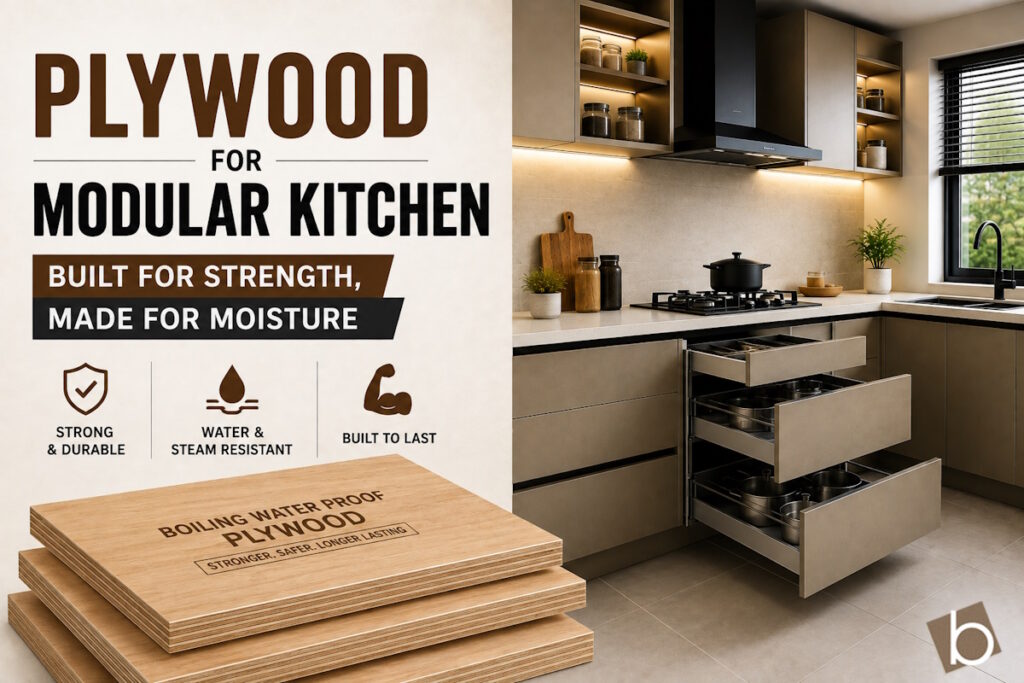
Designing a modular kitchen in an Indian home exposes cabinetry to severe environmental stressors, including high humidity, steam from cooking, water splashes around the sink, and heavy daily loading from utensils and appliances.
When cabinet panels warp, delaminate, or swell near the edges, replacing the damaged sections requires tearing down countertops and dismantling securely fitted hardware, making material selection a critical initial decision.
Designing a modular kitchen in an Indian home exposes cabinetry to severe environmental stressors, including high humidity, steam from cooking, water splashes around the sink, and heavy daily loading from utensils and appliances. When cabinet panels warp, delaminate, or swell near the edges, replacing the damaged sections requires tearing down countertops and dismantling securely fitted hardware, making material selection a critical initial decision.
Choosing the correct plywood for modular kitchen spaces prevents these structural failures, ensuring that base units, wall units, and under-sink storage retain their integrity over years of intensive use. Sourcing quality materials from an established Plywood Manufacturer ensures your kitchen project starts with boards engineered specifically to handle demanding residential and commercial interior environments.
Understanding Moisture Exposure in Indian Kitchens
Indian cooking involves high heat, boiling liquids, oil splatters, and frequent washing of utensils, which creates a microclimate characterized by fluctuating humidity and direct water contact. Unlike dry living room furniture, kitchen carcasses face continuous localized moisture around plumbing lines, dishwasher housings, and countertop joints. Understanding how wood veneers and core veneers react to this moisture determines whether your kitchen layout survives its first monsoon season.
When ordinary interior panels absorb ambient vapor, the wood fibers swell unevenly, causing face veneers to bubble, laminate layers to separate, and screw-holding capacity to degrade rapidly. Selecting the correct plywood grade for kitchen cabinets protects the internal structural core from water ingress. For a deeper dive into how different board categories handle damp conditions, review our guide on Plywood Waterproof Types to understand core bonding technology and resin classifications.
Evaluating Plywood Grades for Kitchen Cabinets
Navigating commercial grades, Boiling Water Resistant grades, and Boiling Water Proof grades can be confusing when specifying materials for modular cabinetry. Each grade utilizes different adhesive formulations and veneer treatments, directly influencing how long the furniture withstands steam and accidental water leaks.
Commercial Plywood Versus Moisture Resistant Options
Standard commercial grade boards use urea-formaldehyde resins that bond interior veneers adequately for dry living room shelving or bedroom wardrobes. However, applying commercial boards inside kitchen base units invites rapid failure upon exposure to routine plumbing leaks or wet cleaning methods. Even though commercial sheets cost less upfront, replacing warped under-sink cabinets within two years eliminates any initial savings.
The Role of BWR Plywood in Kitchen Design
Boiling Water Resistant options utilize synthetic phenol-formaldehyde resin, providing superior resistance to moisture compared to standard commercial sheets. Many homeowners use BWR panels for upper wall cabinets where steam rises but direct water contact remains rare. However, understanding the technical differences between water-resistant standards requires examining resin cure cycles and bond integrity, as detailed in our analysis of BWR Plywood vs BWP Plywood.
Why BWP Plywood Is the Industry Standard for Kitchens
Boiling Water Proof grade represents the highest standard for moisture-laden environments, undergoing rigorous cyclic boiling tests to verify that the adhesive bond does not delaminate under extreme moisture and heat exposure. Using BWP plywood for kitchen carcasses, particularly around the sink unit and dishwasher housing, provides essential protection against permanent water damage. For additional insights on why waterproof bonding matters for food preparation zones, read our detailed breakdown on Marine Plywood for Kitchen applications.
Need help choosing the right plywood grade for your kitchen project?
Determining the Right Thickness for Kitchen Carcasses and Shutters
Specifying the correct board thickness is just as important as selecting the right resin grade. Kitchen furniture supports heavy stone countertops, large appliances, and dense storage items like cast-iron cookware, making structural rigidity non-negotiable.
Thickness Specifications for Base and Wall Units
Base units require robust material thickness to support heavy granite, quartz, or solid surface countertops without sagging over time. Using 18mm thickness for carcass side panels, bottom panels, and internal shelving provides the necessary structural load-bearing capacity. Wall units also benefit from 18mm construction for main structural boxes, though lighter 12mm or 15mm panels are sometimes used for non-load-bearing back panels or internal dividers.
Kitchen Shutter Thickness and Stability
Kitchen cabinet doors, or shutters, face continuous mechanical stress from opening, closing, and hinge movement. While 18mm is the standard thickness for regular shutters to ensure strong screw-holding grip for heavy concealed hinges, tall pantry unit doors require careful consideration to prevent bowing. For wider or taller door panels, pairing high-density boards with Block Board Manufacturer solutions helps maintain straight, warp-free vertical surfaces across large spans.
Core Composition, Face Veneers, and Manufacturing Quality
Not all waterproof boards perform equally, even if they carry the same grade label. The internal construction of the sheet determines its long-term stability, screw retention strength, and resistance to localized impact.
Core Gaps and Timber Density
High-quality kitchen cabinetry requires full-core construction with minimal core gaps between inner veneer strips. Premium manufacturing processes ensure uniform timber density across the entire panel, eliminating hollow spots that compromise screw-holding strength when mounting heavy hydraulic hinges or soft-close channels. Boards with overlapping or gapped core veneers often crack under dynamic loading, causing hardware to pull loose from cabinet walls.
Surface Calibration and Lamination Preparation
Modern modular kitchens rely on smooth surface finishes, whether laminated with high-pressure laminates, acrylic sheets, or membrane foils. Calibrated plywood sheets feature uniform thickness across the entire panel, preventing uneven pressing spots during the lamination process. A smooth, calibrated face veneer eliminates bubbling and ensures a clean, professional finish for modular kitchen shutters and internal visible partitions.
Looking for factory-direct kitchen plywood specifications and bulk pricing?
Common Specification Mistakes to Avoid
Even experienced interior designers and contractors occasionally commit specification errors that shorten the lifespan of modular kitchen installations. Recognizing these common pitfalls prevents expensive rework and client dissatisfaction.
- Using Commercial Plywood Near Sinks: Installing lower-grade interior boards under wet areas leads to rapid edge swelling and structural collapse when minor plumbing leaks occur.
- Ignoring Thickness Requirements for Countertop Support: Using thinner 12mm or 15mm panels for base cabinet vertical supports creates structural sagging under heavy stone countertops.
- Neglecting Edge Banding Protection: Leaving raw plywood edges exposed allows ambient moisture to wick directly into the core veneers, regardless of the core resin grade.
- Overlooking Hardware Screw Retention: Selecting low-density core materials causes hinge screws to strip out under the constant weight and movement of heavy kitchen cabinet doors.
Selecting the Ideal Plywood for Your Modular Kitchen Project
Balancing material performance, structural durability, and project budget requires a methodical approach to specification. Prioritize Boiling Water Proof grades for all moisture-prone zones, especially sink bases, appliance housings, and lower cabinets. Insist on calibrated 18mm sheets for structural carcasses to guarantee secure hardware attachment and reliable countertop support. Confirm that all exposed edges receive proper PVC edge banding to seal the core completely against water vapor ingress. Evaluating your supplier’s manufacturing standards and requesting certified test reports ensures your modular kitchen delivers decades of reliable, trouble-free service.